01 / ONBOARD
A shared starting point for new hires.
Teach the terminology, principles, and troubleshooting fundamentals before asking experienced technicians to build every lesson from scratch.

For employers & enterprise
Your experienced people have a job to do. Give them a structured program to support the next generation: trade fundamentals, virtual practice, and a clear view of who needs help.
For service businesses, facilities teams, and employers developing trade skills.
Walk through the refrigeration cycle—from compressor to evaporator—then change the airflow and watch the readings respond. Selected moments from a real Titan session.
The Titan logo introduces selected moments from an actual recorded session. The learner walks to the compressor, follows the refrigerant to the condenser and metering device, and turns toward the evaporator. Closing the air damper changes the system readings. The film ends with an invitation to see Titan in a demo. Pauses and questions are omitted, and some walking is accelerated. The final airflow response plays at normal speed.
Three reasons to start
Use a defined course alongside supervised work. Choose the program around the role, the learner’s experience, and the work your company needs to support.
01 / ONBOARD
Teach the terminology, principles, and troubleshooting fundamentals before asking experienced technicians to build every lesson from scratch.
02 / DEVELOP
Review HVAC, electrical, plumbing, facilities, or appliance training against employees’ current knowledge and the responsibilities you want them to grow into.
03 / COORDINATE
Organize classes by branch or crew. Give each group the same course sequence, with its own roster, gradebook, and reporting.
See the activities
Review the actual virtual tasks against the roles you are developing. These examples show electrical measurement and plumbing practice.
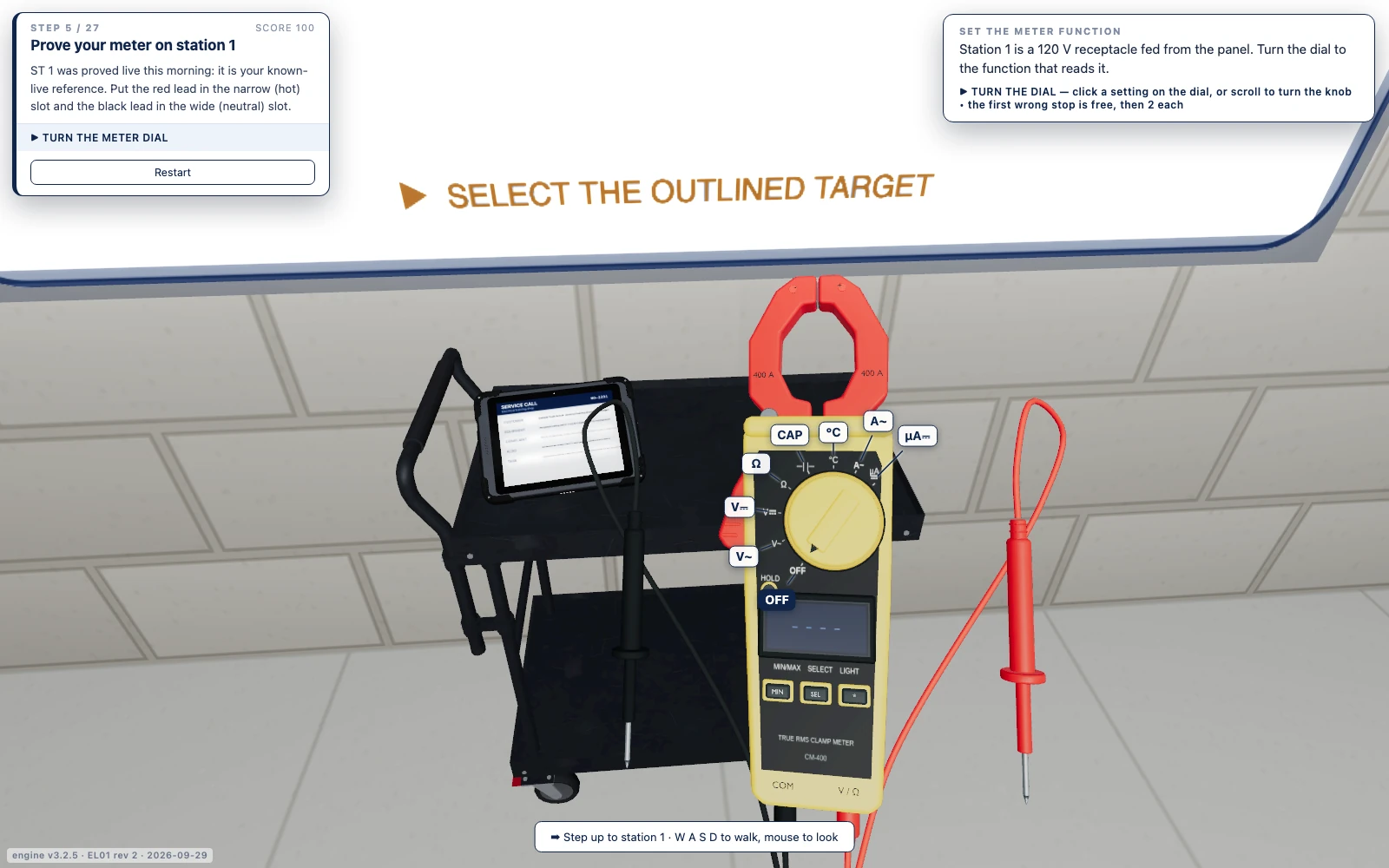
A defined task, the equipment in front of the learner, and instructions for the next measurement.
Open full-size image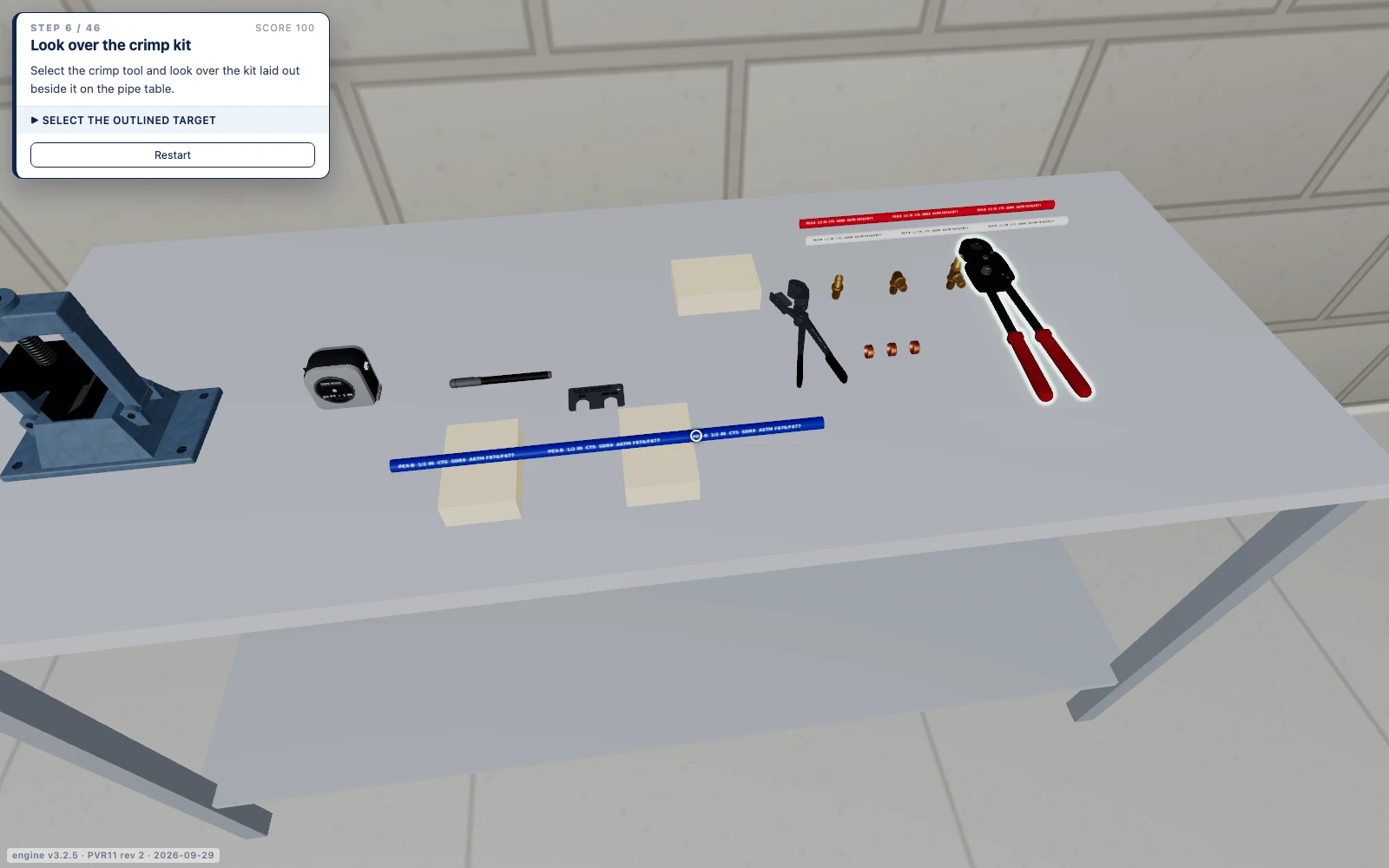
Work through a pipe-joint activity in a virtual workshop, with each task introduced as the learner progresses.
Open full-size imageThe detail behind the training
Review module progress, average course score, time spent, and credential status. Here’s the partner view. We’ll set yours up by branch or crew.
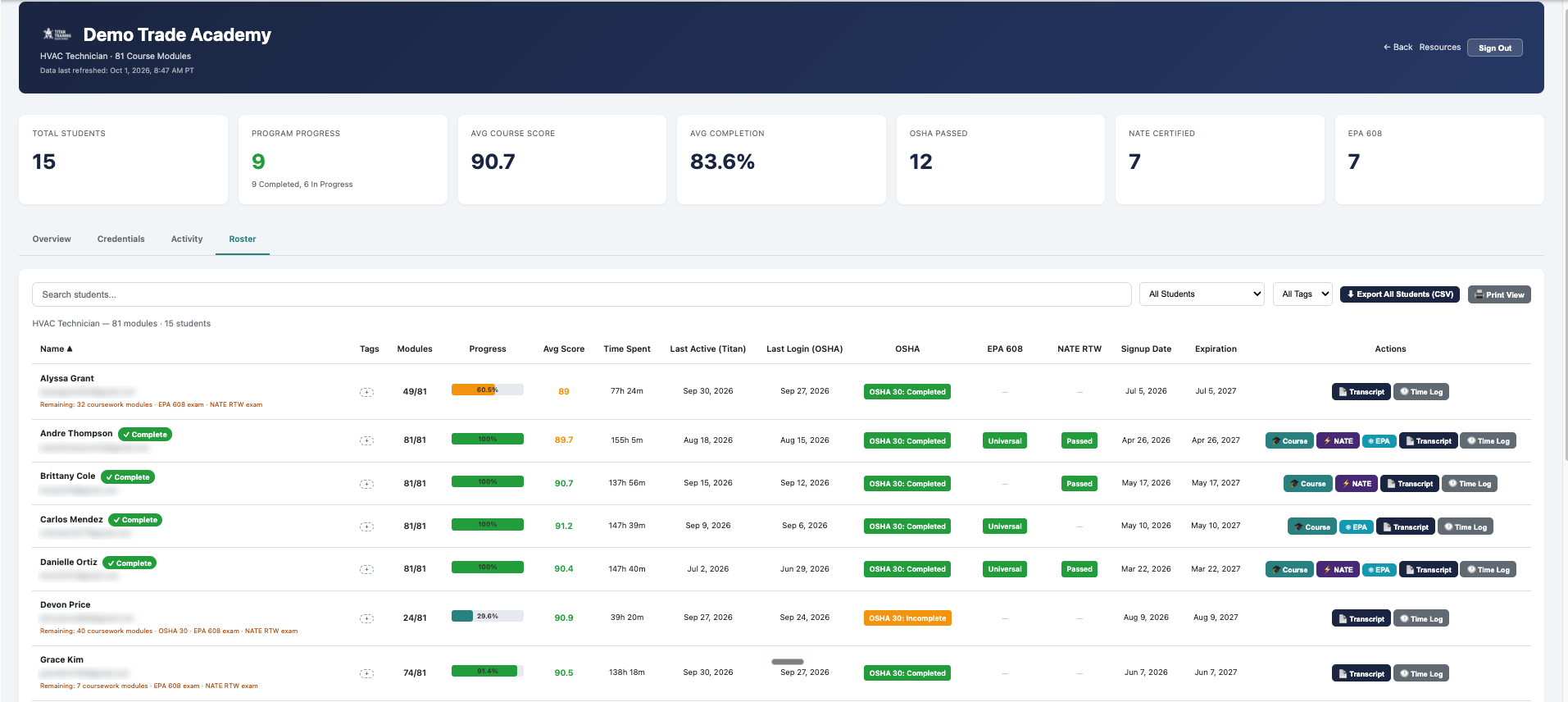
Partner dashboard for a demo school with 15 sample students. Scroll sideways on a small screen, or open the full-size image.
A workable rollout
A defined first cohort lets you see how the course, study schedule, reporting, and supervisor involvement fit your operation.
01 / SCOPE
Bring the job role, current experience, group size, and target start date. There’s no state approval to wait on, so most teams start within weeks of signing.
02 / SCHEDULE
Set aside study time and plan practical coaching. Virtual labs run in a browser on a laptop, Chromebook, or iPad, with nothing to install. Headsets are optional.
03 / REVIEW
Review participation, quiz performance, supervisor observations, and support needs before adding the next crew or location.
Getting started
Licensing is per learner, per program, with 12 months of access from each learner’s start date. Add seats as people join. We’ll put your rollout and pricing on paper after the walkthrough.
Build your team’s proposalRolling out to a larger team? Ask about annual enrollment terms.
Questions from employers
No. State approval is for schools enrolling students. Employers training their own teams can start as soon as the first group is set up, typically within weeks of signing.
No. The coursework and virtual labs build the knowledge and the reps. Your supervisors still sign off on real-world competence.
Yes. Set up a class for each branch or crew, each with its own roster and reporting.
Set a weekly study block with your team. We’ll map a realistic pace for your program and roles on the walkthrough, along with practical coaching and credential timing.
Yes, for the fundamentals they never formally learned. We’ll look at their experience against the course on the demo.
Bring them. The Titan platform is included, and we’ll work through reporting, access, and procurement on the walkthrough.
We’ll open the course and reports, discuss the first group, and put the training scope and price on paper.