Programs

Before you choose a program,
look inside it.

Five trade programs with the hours, course sequence, virtual practice, and people behind them. Find the right starting point for your students or workforce.

The programs at a glance

Choose the work
you’re preparing people for.

Compare the programs below. Starred totals include optional ATC preparation; electrical includes ATC preparation in its standard program.

2026 program catalog · edition 2026.6
ProgramClock hoursModulesVirtual labsOptional ATC prep
HVAC Technician1001330None listed
Electrical Technician150129Included in program
Building & Facilities Maintenance150*20*1914 hours / 1 module*
Plumbing Technician150*12*2120 hours / 1 module*
Appliance Repair Technician100*13*98 hours / 1 module*

* Includes optional ATC hours and one optional module: Facilities, 14 hours (136 base + 14 = 150); Plumbing, 20 hours (130 base + 20 = 150); Appliance Repair, 8 hours (92 base + 8 = 100). Confirm optional preparation and pricing in your proposal.

All programs use asynchronous online instruction, embedded virtual labs, and instructor support. A headset is optional. Clock hours include lab time.

01 / THE PROGRAM

HVAC Technician

100clock hours
13modules
30virtual labs

Understand the system. Then work through the fault.

Build an HVAC foundation from electrical and refrigeration principles through maintenance, evacuation, charging, and furnace troubleshooting.

For schools preparing entry-level HVAC learners and employers developing apprentices, installer assistants, or maintenance teams.

What learners study

  • Trace the refrigeration cycle and explain the role of each component.
  • Apply electrical fundamentals and meter use to HVAC circuits.
  • Work through maintenance, refrigerant-handling, and heating-system scenarios.

Credential preparation & completion

  • NATE Ready-to-Work preparation
  • OSHA 10 Construction training
  • EPA Section 608 Universal preparation

To earn the Titan Certificate of Completion, learners must complete the coursework and pass the NATE Ready-to-Work, OSHA 10 Construction Industry, and EPA Section 608 Universal exams.

View 13 modules and lesson topics

Expand a module to inspect its lessons and embedded labs. Hours include instruction, practice, and assessment; lab time is part of the total.

01Introduction to HVAC5 hrs
  • HVAC Systems
  • Components of an HVAC System
  • How Air Conditioning Works
  • Major Heating Components
  • Basic Tools
02OSHA 10 — Construction Industry10 hrs
  • Introduction to OSHA
  • Fall Hazards
  • Avoiding Electrocution Hazards
  • Struck-By Hazards
  • Caught-In or -Between Hazards
  • Personal Protective Equipment
  • Health Hazards in Construction
  • Excavations
  • Materials Handling, Storage, Use, and Disposal
  • Scaffolds
  • Hand and Power Tools
  • Safe Driving Practices
  • Emergency Action Plans and Fire Protection
  • Cranes
  • Welding and Cutting
  • Final Assessment
03NATE Ready to Work4 hrs
  • NATE Ready to Work Exam Prep Introduction
  • Components
  • Tool Identification and Selection
  • Measurements and Units
  • Basic Heat Transfer
  • General Safety
  • Electrical Safety
  • Virtual lab Safety Orientation & VR Onboarding (PPE, hazard hunt, first lockout/tagout)
04HVAC-Specific Safety2 hrs
  • Compressed Gas Safety
  • Virtual lab A2L Refrigerant (R-32) Handling
05HVAC Fundamentals12 hrs
  • Trades Math
  • Introduction to Refrigeration
  • Temperature
  • Pressure
  • Heat Transfer
  • Evaporators
  • Condensers
  • Refrigerant Overview
  • HVAC Supplies and Aftermarket Parts
  • Virtual lab Refrigeration Cycle — Inside the Loop
  • Virtual lab Commercial Refrigeration: Evaporators & Airflow (Walk-In Cooler)
  • Virtual lab Commercial Refrigeration: Condensers — Airflow, Cleaning & Electrical Faults
06Electrical for HVAC/R33 hrs
  • Atoms & Electrons — Ohm’s Law
  • AC & DC Current
  • Meters, Circuits, Loads, and Switches
  • Symbols and Wiring Diagrams
  • Motors and Motor Starting
  • Compressor Relays and Capacitors
  • Contactors and Motor Starters
  • Troubleshooting Motors
  • Thermostats and Heating Controls
  • Refrigeration Controls and Timers
  • Power Distribution, Delta, and Wye Systems
  • Wire Sizing and Materials
  • Electrical Panels, Circuit Breakers, and Disconnects
  • Virtual lab No-Cool Service Call — Condenser Electrical Diagnostics
  • Virtual lab Hard Start / Dual Run Capacitor Diagnosis
  • Virtual lab Surge Protectors
  • Virtual lab Blower Motor Replacement
  • Virtual lab Condenser Fan Motor Replacement
  • Virtual lab Commercial Refrigeration: Compressors — Electrical Checks, Efficiency & Changeout
  • Virtual lab Commercial Refrigeration: Metering Devices & System Controls
07HVAC Maintenance5 hrs
  • HVAC Preventive Maintenance
  • Cooling Season Tune Up
  • Heating Season Tune Up
  • Filters and Airflow Maintenance
  • Combustion Analysis and CO Safety
  • Documentation and Reporting
  • Virtual lab Blower Wheel Cleaning
  • Virtual lab Drain Pan Alignment
  • Virtual lab Primary Drain Line Safety Switch
  • Virtual lab Secondary Drain Pan Safety Switch
  • Virtual lab UV Air Purifier Service
  • Virtual lab Commercial Refrigeration: Ice Machine Service (Water-Cooled Cuber)
08Evacuation and Charging3 hrs
  • Evacuation and Charging
  • Virtual lab Evacuation & Pressure Test
  • Virtual lab Weigh-In Charging
  • Virtual lab Lineset Installation & Nitrogen Pressure Test
  • Virtual lab Ductless Mini-Split Installation
09HVAC Troubleshooting4 hrs
  • Troubleshooting Mindset
  • Electrical Troubleshooting
  • No Cool Call
  • No Heat Call
  • Airflow and Thermostat Diagnosis
  • Compressor Mechanical
  • Virtual lab Air Handler Airflow Diagnostics (Capstone)
  • Virtual lab Commercial Refrigeration: Troubleshooting Capstone
10EPA Section 608 Universal8 hrs
  • EPA 608 Welcome Video
  • EPA Core
  • EPA Type I
  • EPA Type II
  • EPA Type III
  • EPA 608 Study Guide, Core and Type Study Sheets, and PT Chart (reference materials)
  • Virtual lab Refrigerant Recovery — Type II Split System
  • Virtual lab Small Appliance Refrigerant Recovery (Type I)
  • Virtual lab Low-Pressure Chiller Refrigerant Recovery (Type III)
11Gas Furnace Sequence of Operations2 hrs
  • Gas Furnace Sequence of Operations
  • Virtual lab Gas Furnace Sequence of Operations — No-Heat Call
12Gas Furnace Simulations (VR)10 hrs
  • Virtual lab Gas Furnace: General Troubleshooting
  • Virtual lab Gas Furnace: Dirty Filter
  • Virtual lab Gas Furnace: Faulty Flame Sensor
  • Virtual lab Gas Furnace: Faulty Gas Valve
  • Virtual lab Gas Furnace: Faulty Gas Wire
  • Virtual lab Gas Furnace: Faulty HSI
  • Virtual lab Gas Furnace: Faulty IFC
  • Virtual lab Gas Furnace: Faulty Switch
  • Virtual lab Gas Furnace: Faulty Thermostat
  • Virtual lab Gas Furnace: Loose IFC Wire
  • Virtual lab Gas Furnace: Loose Thermostat Wire
  • Virtual lab Gas Furnace: All Modules
13Electric Furnace Sequence of Operations2 hrs
  • Electric Furnace Sequence of Operations
  • Virtual lab Heat Pump Reversing Valve Diagnosis

OSHA 10 training is delivered through CareerSafe Online. Module titles and hours follow Titan’s 2026.6 catalog and confirmed program updates.
02 / THE PROGRAM

Electrical Technician

150clock hours
12modules
9virtual labs

A circuit is easier to troubleshoot when you understand how it works.

Teach electrical theory, safe measurement, wiring methods, residential NEC essentials, panels, motors, controls, and low-voltage systems in one sequenced program.

For entry-level electrical learners, apprentices, and employees building a foundation for supervised electrical maintenance.

What learners study

  • Apply electrical theory to voltage, current, and resistance measurements.
  • Study conductors, circuit protection, grounding, and residential wiring.
  • Build familiarity with motor controls, lighting, and systematic troubleshooting.

Credential preparation & completion

  • OSHA 10 Construction training
  • NFPA 70E awareness content
  • ATC Electrical Fundamentals preparation — included in the base program
View 12 modules and lesson topics

Expand a module to inspect its lessons and embedded labs. Hours include instruction, practice, and assessment; lab time is part of the total.

01Introduction to the Electrical Trade6 hrs
  • Introduction to the Electrical Trade
  • Ethical Work Practices & Customer Service
  • Electrical Safety & Hazard Awareness
  • Virtual lab Safety Orientation & VR Onboarding (PPE, hazard hunt, first lockout/tagout)
02OSHA 10 — Construction Industry10 hrs
  • Introduction to OSHA
  • Fall Hazards
  • Avoiding Electrocution Hazards
  • Struck-By Hazards
  • Caught-In or -Between Hazards
  • Personal Protective Equipment
  • Health Hazards in Construction
  • Excavations
  • Materials Handling, Storage, Use, and Disposal
  • Scaffolds
  • Hand and Power Tools
  • Safe Driving Practices
  • Emergency Action Plans and Fire Protection
  • Cranes
  • Welding and Cutting
  • Final Assessment
03Tools, Meters, & Test Equipment12 hrs
  • Hand Tools for Electrical Work
  • Power Tools & Specialty Equipment
  • Meters & Diagnostic Instruments
04Electrical Theory and Fundamentals20 hrs
  • Atoms, Electrons, & Electrical Flow
  • Voltage, Current, and Resistance
  • Virtual lab Measuring Voltage
  • Ohm’s Law & Power Formulas
  • Series, Parallel, & Combination Circuits
  • AC vs DC: Waveforms, Frequency, & Phase
  • Virtual lab Measuring Amperage
  • Virtual lab Component Resistance
05Wiring Methods & Materials14 hrs
  • Wire Types, Sizes, & The AWG System
  • Virtual lab Selecting Wire Gauges
  • Conduit Types & Installation
  • Cable Routing, Supports, and Protection
  • Boxes, Fittings, and Connectors
06Residential Wiring & NEC Essentials22 hrs
  • NEC Overview & How to Navigate the Codebook
  • Branch Circuits & Load Calculations
  • Virtual lab Wiring a Circuit
  • Receptacle Layout & GFCI/AFCI Protection
  • Lighting Circuits & Switch Configurations
  • Service Entrance & Grounding/Bonding
07Electrical Panels and Power Distribution10 hrs
  • Panel Components & Circuit Breakers
  • Single-Phase vs Three-Phase Power
  • Transformers and Power Distribution
  • Virtual lab Surge Protectors
08Motors, Controls, and Troubleshooting14 hrs
  • Electric Motor Types and Applications
  • Motor Starting & Protection
  • Control Circuits & Relay Logic
  • Systematic Troubleshooting Methods
  • Virtual lab Diagnosing a Faulty Keypad
  • Virtual lab SIM-P05B — Troubleshooting an Electric Water Heater
09Low Voltage & Communication Systems8 hrs
  • Doorbell, Thermostat, and Security Systems
  • Data / Communication Cabling Basics
  • Smart Home & Building Automation Awareness
10Lighting Systems8 hrs
  • Lamp Types & Efficiency
  • Fixture Installation and Troubleshooting
  • Emergency & Exit Lighting
11Career Readiness and Job Transition6 hrs
  • Electrical Career Pathways
  • Resume Writing
  • Interviewing and First Day Success
12ATC Electrical Fundamentals Prep20 hrs
  • Domain 1 Review: Electrical Safety
  • Domain 2 Review: NEC General Provisions (Articles 100 & 110)
  • Domain 3 Review: Branch Circuits (Article 210)
  • Domain 4 Review: Feeders & Services (Articles 215 & 230)
  • Domain 5 Review: Conductor Sizing & Overcurrent (Articles 240 & 310)
  • Domain 6 Review: Grounding and Bonding (Article 250)
  • Domain 7 Review: Boxes, Raceways & Wiring Methods
  • Domain 8 Review: Conduit Bending & Methods
  • Domain 9 Review: Electrical Calculations
  • ATC Practice Exam & Review
  • Practice Exam

OSHA 10 training is delivered through CareerSafe Online. Module titles and hours follow Titan’s 2026.6 catalog and confirmed program updates.
03 / THE PROGRAM

Building & Facilities Maintenance

150*clock hours
20*modules
19virtual labs

One building. More than one trade to understand.

Cover the systems a maintenance team encounters across a property: electrical, plumbing, HVAC, appliances, mechanical equipment, building controls, and preventive maintenance.

For facilities and property-maintenance teams, new maintenance hires, and schools preparing learners for broad maintenance roles.

What learners study

  • Build a working foundation across electrical, plumbing, HVAC, and appliance systems.
  • Study building controls, mechanical systems, and equipment maintenance.
  • Use preventive-maintenance schedules, work orders, and maintenance-management concepts.

Credential preparation & completion

  • OSHA 10 General Industry training
  • EPA Section 608 Type I preparation

NATE Ready-to-Work is not required for this program.

* Includes optional ATC hours: ATC Maintenance Technician certification preparation

The 150-hour total includes 14 optional hours and one optional module. Without this preparation: 136 hours across 19 modules. Confirm add-on scope and pricing in your proposal.

View 19 modules and lesson topics + optional module

Expand a module to inspect its lessons and embedded labs. Hours include instruction, practice, and assessment; lab time is part of the total.

01Introduction to Building and Facility Maintenance4 hrs
  • Introduction to Building and Facilities Maintenance
  • Ethical Repair and Customer Service
  • Safety Fundamentals and Job Site Awareness
  • Virtual lab Safety Orientation & VR Onboarding (PPE, hazard hunt, first lockout/tagout)
02OSHA 10 — General Industry (Complete OSHA 10 Before Advancing)10 hrs
  • Introduction to OSHA
  • Walking and Working Surfaces (including fall protection)
  • Exit Routes, Emergency Action Plans, Fire Prevention Plans, and Fire Protection
  • Electrical
  • Personal Protective Equipment
  • Hazard Communication
  • Elective topics (selected by the Outreach provider): Hazardous Materials, Materials Handling, Machine Guarding, Bloodborne Pathogens, Ergonomics, Safety and Health Programs, Fall Protection
  • Final Assessment
03Tools6 hrs
  • Hand Tools for Facility Maintenance
  • Power Tools and Safety
  • Precision Measurement & Layout
  • Specialty Diagnostic Tools
  • Virtual lab SIM-P02 — Using Core Plumbing Hand Tools
04Electrical Fundamentals12 hrs
  • Electrical Hazards & Arc Flash
  • Introduction to Electrical Basics
  • Electron Flow & Circuit Logic
  • Electrical Components
  • Ohm’s Law in Practice
  • Circuits and Troubleshooting
05Virtual Reality Labs5 hrs
  • Virtual lab Electrician Appliance: Measuring Voltage
  • Virtual lab Electrician Appliance: Measuring Amperage
  • Virtual lab Electrician Appliance: Component Resistance
  • Virtual lab Electrician Appliance: Selecting Wire Gauges
  • Virtual lab Electrician Appliance: Wiring a Circuit
  • Virtual lab Electrician Appliance: Diagnosing Faults
06Garbage Disposals4 hrs
  • Types/Styles and Theory of Operation
  • Key Components by Sequence of Operations
  • Diagnostics & Troubleshooting
  • Installation
07Dishwashers5 hrs
  • Dishwasher Basics and Repair
  • Theory of Operations
  • Key Components by Sequence of Operation
  • Diagnostics and Troubleshooting
  • Installation
08Clothes Dryers6 hrs
  • Gas Combustion
  • Principles of Drying
  • Installation
  • Dryer Components, Wiring, and Troubleshooting
  • Dryer Gas Burner System
09Washers10 hrs
  • Types and Styles
  • Theory of Operations
  • Key Components by Sequence of Operations
  • Agitation and Tumble
  • Motors and Pumps
  • Drive Systems
  • Suspension Systems
  • Washer Chemistry — Water & Detergents
  • Troubleshooting & Diagnostics
  • Installation
10Gas Cooking Appliances6 hrs
  • Understanding Gas Systems and Safety
  • Proper Burner Combustion & Safety
  • Flame Characteristics & Ignition
  • Direct Spark Ignition
  • Adjustment and Repair Procedures to Minimize Carbon Monoxide Exposure
11Electric Cooking Appliances8 hrs
  • Theory of Operation — Radiant & Induction
  • Types and Styles
  • Cooktop Surface and Components
  • Oven Cooking and Components
  • Oven Door and Components
  • Self-Clean and Components
  • Convection, Steam Cooking, and Components
  • Electric Cooking Appliances Troubleshooting Basics
12Refrigeration and Cooling Systems10 hrs
  • Basic Refrigeration
  • Brazing and Lok Ring
  • Recovery, Evacuation, and Leak Detection
  • Window AC
  • Refrigerant Recovery, Recycling, System Evacuation, Leak Detection, and Recharging
  • Ice Maker Troubleshooting
  • Ice Machine Troubleshooting
  • Virtual lab Refrigeration Cycle — Inside the Loop
13HVAC for Facilities10 hrs
  • HVAC Fundamentals and the Comfort Triangle
  • Air Distribution Systems
  • Heating Systems
  • Cooling Systems
  • Thermostats & BAS Interfaces
  • Ventilation and Indoor Air Quality
  • Virtual lab Blower Wheel Cleaning
  • Virtual lab Drain Pan Alignment
  • Virtual lab UV Air Purifier Service
14EPA 608 — Type I Prep4 hrs
  • EPA 608 Core
  • EPA 608 Type 1
  • Virtual lab Small Appliance Refrigerant Recovery (Type I)
15Mechanical Systems8 hrs
  • Bearings, Belts, and Pulleys
  • Lubrication Schedules
  • Vibration Basics
  • Fasteners & Torque Awareness
  • Pumps and Fans
  • Virtual lab Blower Motor Replacement
  • Virtual lab Condenser Fan Motor Replacement
16Plumbing and Water Systems10 hrs
  • Valves and Fittings
  • Toilets, Urinals, and Sinks
  • Drain Clearing
  • Leak Diagnostics
  • Backflow Code and Boundaries
  • Water Heaters
  • Virtual lab SIM-P03 — Installing a Kitchen Faucet
  • Virtual lab SIM-P04 — Installing a Toilet
  • Virtual lab SIM-P05A — Troubleshooting a Gas Water Heater
  • Virtual lab SIM-P05B — Troubleshooting an Electric Water Heater
17Building Systems and Controls6 hrs
  • Doors, Locks, and Panic Hardware
  • Lighting Systems and Ballasts
  • Emergency Lighting
  • Fire Alarm Systems and Generators
18Preventive Maintenance8 hrs
  • Preventive Maintenance Fundamentals
  • CMMS Software Fundamentals
  • Asset Management and Tagging
  • PM Checklists and Execution
  • Seasonal Changeover and Planning
19Career Support4 hrs
  • Starting Your Job Search
  • Resume Tips & Examples
  • Interviewing for Success
  • What to Expect on Your 1st Day
20ATC Certification Prep (Optional Add-On)14 hrs
  • Electrical Maintenance
  • Plumbing Maintenance
  • HVAC Maintenance
  • Carpentry & General
  • Life Safety
  • Preventive Maintenance & Work Orders
  • Safety & Multi-Hazard Awareness

OSHA 10 training is delivered through CareerSafe Online. Module titles and hours follow Titan’s 2026.6 catalog and confirmed program updates.

04 / THE PROGRAM

Plumbing Technician

150*clock hours
12*modules
21virtual labs

Follow the water. Understand the system behind it.

Move from tools, water science, and pipe materials into joining methods, water supply, drain-waste-vent systems, fixtures, and maintenance.

For schools preparing plumbing learners and employers building foundational skills for apprentices, service helpers, and maintenance staff.

What learners study

  • Compare pipe materials and the joining method each requires.
  • Study water supply, drainage, venting, fixtures, and backflow fundamentals.
  • Work through common inspection, leak-repair, and water-heater scenarios.

Credential preparation & completion

  • OSHA 10 Construction training
  • Titan program certificate of completion
* Includes optional ATC hours: ATC Plumbing certification preparation

The 150-hour total includes 20 optional hours and one optional module. Without this preparation: 130 hours across 11 modules. Confirm add-on scope and pricing in your proposal.

View 11 modules and lesson topics + optional module

Expand a module to inspect its lessons and embedded labs. Hours include instruction, practice, and assessment; lab time is part of the total.

01Introduction and Ethics6 hrs
  • Introduction to Plumbing
  • Ethical Work Practices & Customer Service
  • Plumbing Safety & Hazard Awareness
02OSHA 10 — Construction Industry10 hrs
  • Introduction to OSHA
  • Fall Hazards
  • Avoiding Electrocution Hazards
  • Struck-By Hazards
  • Caught-In or -Between Hazards
  • Personal Protective Equipment
  • Health Hazards in Construction
  • Excavations
  • Materials Handling, Storage, Use, and Disposal
  • Scaffolds
  • Hand and Power Tools
  • Safe Driving Practices
  • Emergency Action Plans and Fire Protection
  • Cranes
  • Welding and Cutting
  • Final Assessment
03Tools, Material, and Measurement10 hrs
  • Plumbing Hand Tools
  • Power Tools and Specialty Equipment
  • Measurement and Layout
  • Virtual Reality Lab
  • Virtual lab SIM-P02 — Using Core Plumbing Hand Tools. Students identify and operate the core plumbing hand-tool set — pipe wrenches, basin wrenches, tubing cutters, deburring tools, channel locks, and threaders — in a controlled VR environment before transitioning to field tasks.
04Plumbing Fundamentals and Water Science12 hrs
  • Water Properties: Pressure and Flow
  • The Plumbing System as a Whole
  • Blueprint Reading and Plumbing Drawings
  • Plumbing Code Awareness
05Pipe Types, Fittings, & Joining Methods18 hrs
  • Copper Pipe and Tubing
  • PVC, CPVC, and ABS Plastic Pipe
  • PEX Tubing
  • Cast Iron, Galvanized, and Specialty Pipe
  • Virtual Reality Lab
  • Virtual lab SIM-P01 — Soldering a Copper Pipe Joint. Students complete the full soldering workflow — joint cleaning and sanding, flux application, torch handling, sweat-soldering technique, and leak verification — in a controlled VR environment before live torch work.
  • Virtual lab PVC & ABS Solvent-Weld DWV Joints. Students measure, cut, deburr, prime, and solvent-weld PVC and ABS drain fittings, matching the correct cement to each pipe material.
  • Virtual lab Threading Black Steel Pipe. Students cut, ream, and thread black steel pipe in a yoke vise with cutting oil, inspect the threads, and make up a sealed threaded joint.
  • Virtual lab PEX-A Expansion Joints. Students cut PEX-A tubing square, expand it onto expansion fittings, and verify each joint.
  • Virtual lab PEX-B Crimp Joints. Students make PEX-B crimp joints and verify every ring with a GO/NO-GO gauge.
  • Virtual lab Copper Press & Push-Fit Connections. Students prepare copper tube, mark insertion depth, make press and push-fit joints, and verify them by indicator check and pressure test.
  • Virtual lab Cast Iron No-Hub Repair. Students cut out a section of 4 in cast iron with a soil pipe snap cutter and install no-hub couplings torqued to specification.
06Water Supply Systems14 hrs
  • Water Distribution Fundamentals
  • Fixture Supply & Rough-In
  • Water Heaters: Gas, Electric, and Tankless
  • Backflow Prevention & Cross-Connection Control
  • Boiler Systems & Hydronic Heating Awareness
  • Virtual Reality Lab
  • Virtual lab Water-Supply Pressure Test. Students cap and pressurize a copper supply section with a hydrostatic test pump, hold and read the test gauge, and locate the source of any pressure drop.
  • Virtual lab Supply-Line Leak Repair. Students isolate the water supply, locate a pinhole or split copper line, and repair it with repair couplings or a repair clamp.
  • Virtual lab Tankless Water Heater Descale & Inlet Filter. Students isolate power, gas, and water to a tankless heater, flush the heat exchanger with a descaling pump, and clean the inlet filter.
07Drain, Waste, and Vent Systems12 hrs
  • DWV Principles & Code Requirements
  • Drain & Waste Pipe Sizing and Slope
  • Traps, Cleanouts, & Common DWV Configurations
  • Drain Clearing and Troubleshooting
  • Virtual Reality Lab
  • Virtual lab Kitchen Sink Drain Clearing. Students clear a blocked kitchen sink drain with a drum auger through the trap arm, then reassemble and leak-test the drain.
  • Virtual lab Sewer Camera Inspection. Students run a sewer camera through a floor cleanout, interpret the live view, and identify and record the pipe defect.
  • Virtual lab Garbage Disposal Jam & Sink Drain. Students unplug a jammed disposal, free the flywheel, reset and test the unit, and verify the sink drain.
08Fixtures and Appliance Connections18 hrs
  • Toilets: Installation, Repair, and Troubleshooting
  • Faucets, Sinks, and Lavatories
  • Bathtubs, Showers, & Tub/Shower Valves
  • Appliance Connections
  • Virtual Reality Lab
  • Virtual lab SIM-P03 — Installing a Kitchen Faucet. Students complete a full kitchen faucet installation — supply-line connection, mounting, sealing, and leak verification — in a controlled VR environment.
  • Virtual lab SIM-P04 — Installing a Toilet. Students complete a full toilet installation — wax-ring setting, closet-bolt alignment, supply connection, level check, and flush test — in VR before the live skills assessment.
  • Virtual lab Toilet Running / Tank Rebuild. Students diagnose a running toilet with a dye test and rebuild the tank internals.
  • Virtual lab Single-Handle Faucet Cartridge Replacement. Students diagnose a dripping, low-flow kitchen faucet, service the aerator, and replace the cartridge.
09Gas Piping Awareness8 hrs
  • Natural Gas and Propane Safety
  • Gas Piping Materials & Connections
  • Gas Appliance Connections & Testing
10Preventive Maintenance & Inspection16 hrs
  • PM Schedules for Plumbing Systems
  • Common Plumbing Failures & Early Detection
  • Inspection Checklists & Documentation
  • Boiler Preventive Maintenance
  • Virtual Reality Lab
  • Virtual lab SIM-P05A — Troubleshooting a Gas Water Heater. Students perform a structured diagnosis on a residential gas water heater — pilot/igniter diagnosis, gas valve testing, thermocouple checks, and combustion safety verification — in VR before field service.
  • Virtual lab SIM-P05B — Troubleshooting an Electric Water Heater. Students diagnose a residential electric water heater — element resistance testing, thermostat diagnosis, and T&P valve verification — applying multimeter techniques in a 240V appliance context.
  • Virtual lab Tank Water Heater: Anode & T&P Valve Service. Students shut off and verify power at the heater, isolate the water, inspect and replace the anode rod, and test and replace the T&P valve.
11Career Readiness and Job Transition6 hrs
  • Plumbing Career Pathways
  • Resume Writing (Plumbing-Focused)
  • Interviewing & First Day Success
12ATC Certification Prep (Optional Add-On)20 hrs
  • Plumbing Safety
  • IPC Fundamentals (Articles, Definitions, Permits)
  • UPC Fundamentals (and Differences from IPC)
  • Water Supply & Distribution
  • DWV (Drain, Waste, Vent) Systems
  • Joining Methods & Materials
  • Fixtures & Rough-In Dimensions
  • Backflow Prevention & Cross-Connection Control
  • Plumbing Calculations

OSHA 10 training is delivered through CareerSafe Online. Module titles and hours follow Titan’s 2026.6 catalog and confirmed program updates.

05 / THE PROGRAM

Appliance Repair Technician

100*clock hours
13*modules
9virtual labs

Build the diagnostic foundation behind the service call.

Start with electrical fundamentals, then cover washers, dryers, refrigeration, gas and electric cooking equipment, garbage disposals, and dishwashers.

For appliance-service trainees, new service hires, property-maintenance teams, and schools preparing entry-level repair technicians.

What learners study

  • Use electrical fundamentals to reason through appliance faults.
  • Study operating sequences, major components, and repair procedures by appliance.
  • Build a foundation in refrigeration and small-appliance refrigerant recovery.

Credential preparation & completion

  • OSHA 10 General Industry training
  • EPA Section 608 Core + Type I preparation

Includes 12.5 hours of lab practice. The 100-hour version comprises 87.5 lecture hours and 12.5 lab hours; without optional ATC preparation, the 92-hour program comprises 79.5 lecture hours and 12.5 lab hours.

* Includes optional ATC hours: ATC Appliance Repair certification preparation

The 100-hour total includes 8 optional hours and one optional module. Without this preparation: 92 hours across 12 modules. Confirm add-on scope and pricing in your proposal.

View 12 modules and lesson topics + optional module

Expand a module to inspect its lessons and embedded labs. Hours include instruction, practice, and assessment; lab time is part of the total.

01Introduction to Appliance Repair3 hrs
  • Introduction to Appliance Repair
  • Ethical Repair and Customer Service
  • Basic Tools
  • Virtual lab Safety Orientation & VR Onboarding (PPE, hazard hunt, first lockout/tagout)
02OSHA 10 — General Industry10 hrs
  • Introduction to OSHA
  • Walking and Working Surfaces (including fall protection)
  • Exit Routes, Emergency Action Plans, Fire Prevention Plans, and Fire Protection
  • Electrical
  • Personal Protective Equipment
  • Hazard Communication
  • Elective topics (selected by the Outreach provider): Hazardous Materials, Materials Handling, Machine Guarding, Bloodborne Pathogens, Ergonomics, Safety and Health Programs, Fall Protection
  • Final Assessment
03Electrical Fundamentals12 hrs
  • Shocks and Hazards
  • Introduction to Electrical Basics
  • Digital Meters
  • Electron Flow
  • Electrical Components
  • Ohm’s Law
  • Electrical Circuits
04Virtual Reality Labs6 hrs
  • Virtual lab Electrician Appliance: Measuring Voltage
  • Virtual lab Electrician Appliance: Measuring Amperage
  • Virtual lab Electrician Appliance: Component Resistance
  • Virtual lab Electrician Appliance: Selecting Wire Gauges
  • Virtual lab Electrician Appliance: Wiring a Circuit
  • Virtual lab Electrician Appliance: Diagnosing Faults
05Clothes Dryers7 hrs
  • Gas Combustion
  • Principles of Drying
  • Installation
  • Dryer Components, Wiring, and Troubleshooting
  • Dryer Gas Burner System
06Refrigeration and Cooling Systems10 hrs
  • Basic Refrigeration
  • Brazing and Lok Ring
  • Refrigerant Recovery, Recycling, System Evacuation, Leak Detection, and Recharging
  • Window AC
  • Ice Maker Troubleshooting
  • Ice Machine Troubleshooting
  • Virtual lab Refrigeration Cycle — Inside the Loop
07Washers12 hrs
  • Types and Styles
  • Theory of Operations
  • Key Components by Sequence of Operations
  • Agitation and Tumble
  • Motors and Pumps
  • Drive Systems
  • Suspension Systems
  • Washer Chemistry — Water & Detergents
  • Troubleshooting & Diagnostics
  • Installation
08Gas Cooking Appliances7 hrs
  • Understanding Gas Systems and Safety
  • Proper Burner Combustion & Safety
  • Flame Characteristics & Ignition
  • Direct Spark Ignition
  • Adjustment and Repair Procedures to Minimize Carbon Monoxide Exposure
09Electric Cooking Appliances10 hrs
  • Theory of Operation — Radiant & Induction
  • Types and Styles
  • Cooktop Surface and Components
  • Oven Cooking and Components
  • Oven Door and Components
  • Self-Clean and Components
  • Convection, Steam Cooking, and Components
  • Electric Cooking Appliances Troubleshooting Basics
10Garbage Disposals4 hrs
  • Types/Styles and Theory of Operation
  • Key Components by Sequence of Operations
  • Diagnostics & Troubleshooting
  • Installation
11Dishwashers6 hrs
  • Dishwasher Basics and Repair
  • Theory of Operations
  • Key Components by Sequence of Operation
  • Diagnostics and Troubleshooting
  • Installation
12Exam Preparation — EPA 6085 hrs
  • EPA 608 Core
  • EPA 608 Type 1
  • Virtual lab Small Appliance Refrigerant Recovery (Type I)
13ATC Certification Prep (Optional Add-On)8 hrs
  • Electrical Safety, Multimeter Use & Circuit Reading
  • Refrigerator & Freezer Systems
  • Laundry — Washers & Dryers
  • Cooking Equipment — Gas & Electric Ranges, Ovens, Microwaves
  • Dishwashers
  • Customer Service & Service Documentation
  • Tools, Parts & Service Practices

OSHA 10 training is delivered through CareerSafe Online. Module titles and hours follow Titan’s 2026.6 catalog and confirmed program updates.

How the program works

A sequence to follow.
A person to turn to.

Each program has a named instructor of record, module assessments, and weekly office hours. Your school or company provides the practical training and supervision required for its learners.

Learn at your own pace

Asynchronous lessons fit around a training schedule. Module assessments govern progress through the course.

Practice in a browser

Labs run on Windows, macOS, Chromebook, and iPad. Optional Meta Quest 3 support adds a headset experience.

Review the full picture

Track course progress, scores, learning activity, and credential status in the partner dashboard.

Catalog modules group lessons and assessments. The learning portal can display individual lessons and supporting items, so its item count can be higher than the module count above.

Actual Titan simulations

Inspect the practice.

Open a full-size image to see the task and equipment inside the electrical and plumbing labs.

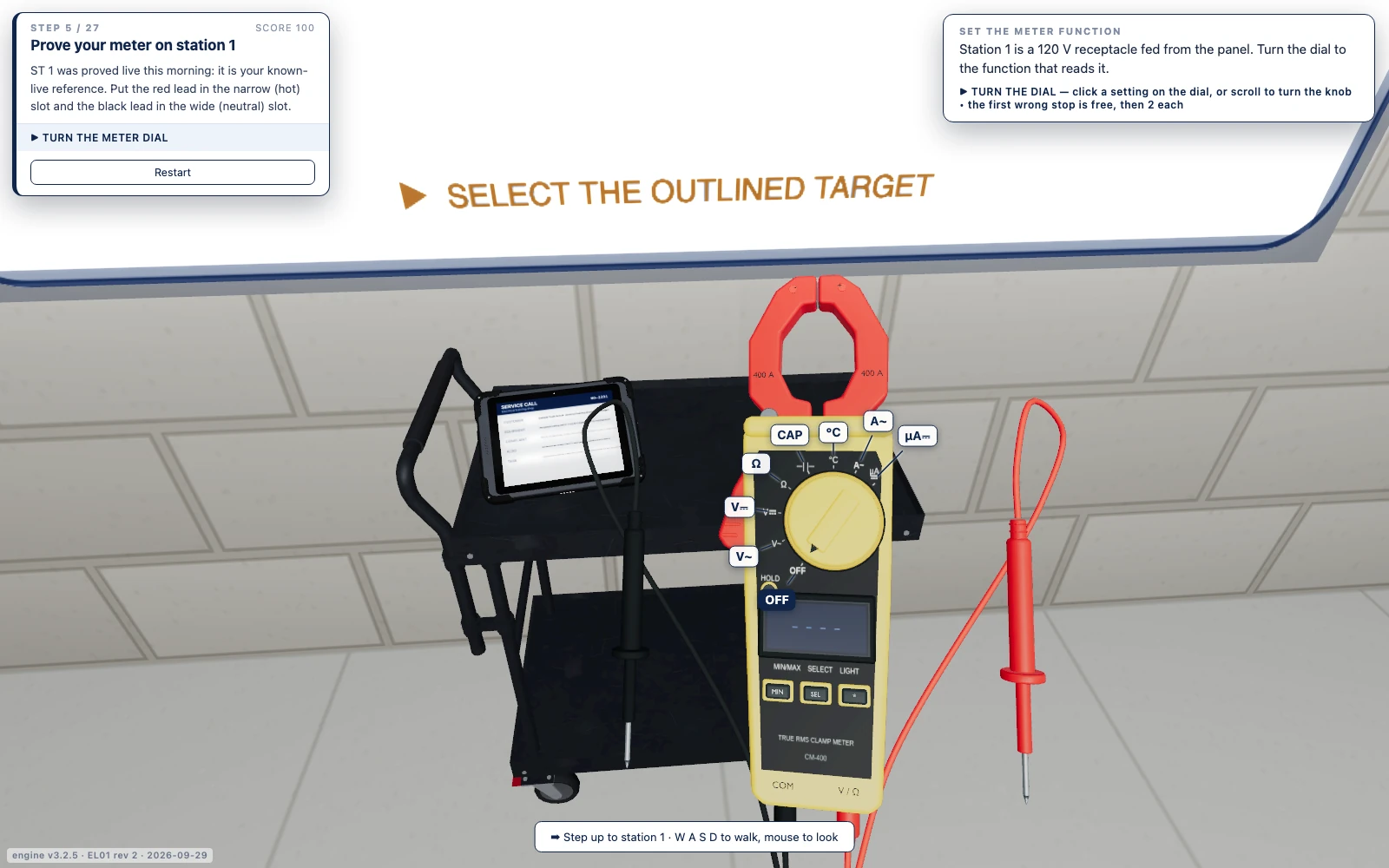
Titan Measuring Voltage simulation showing the meter function selector and instructions for the current task.
Electrical · Measuring voltage

A defined task, the equipment in front of the learner, and instructions for the next measurement.

Open full-size image
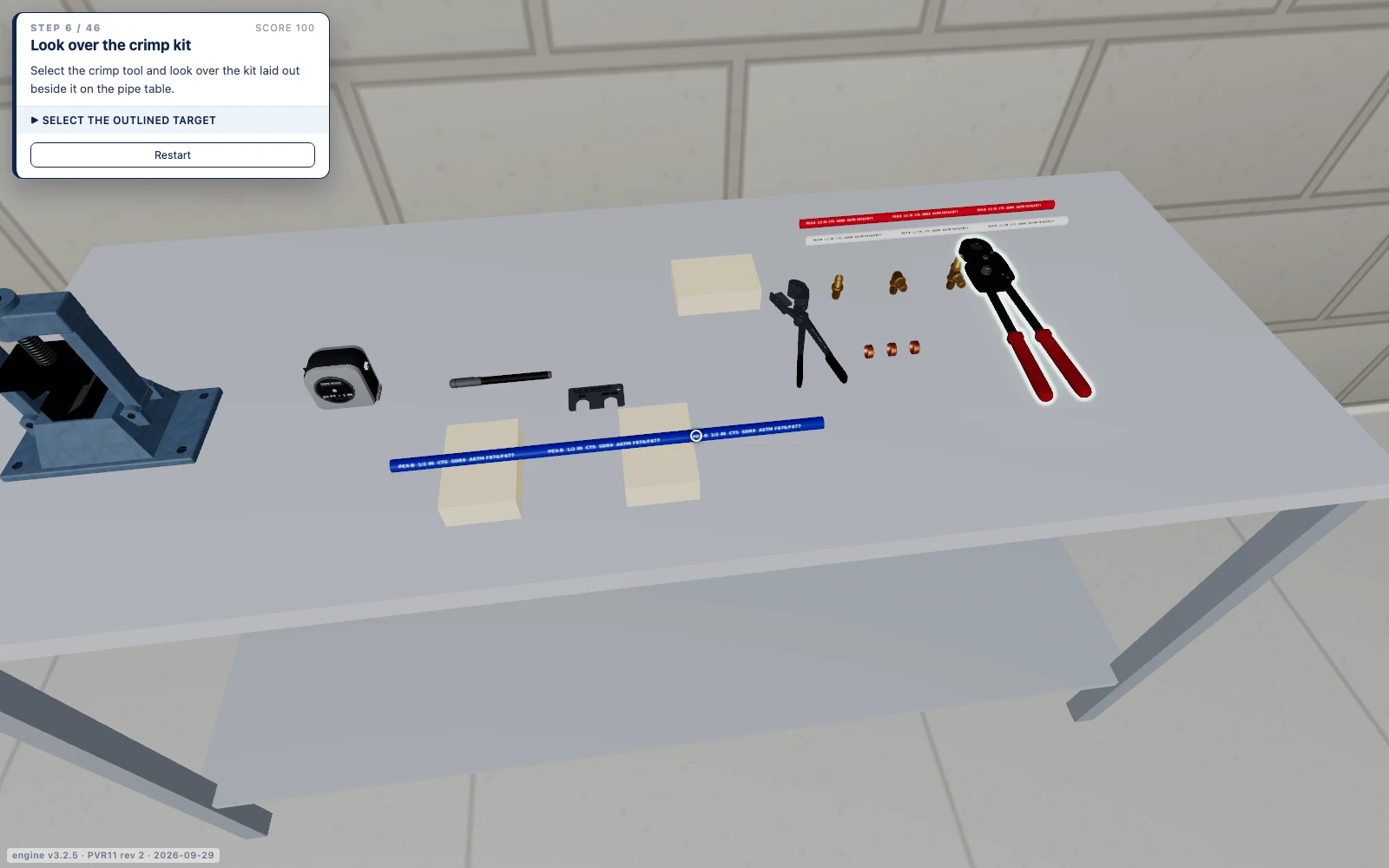
Titan PEX-B Crimp Joints simulation showing the pipe workbench and the current task.
Plumbing · PEX-B crimp joints

Work through a pipe-joint activity in a virtual workshop, with each task introduced as the learner progresses.

Open full-size image

Inside the course

See how a lesson becomes practice.

In your demo, follow a lesson into its lab and assessment, then see the learner’s progress in the report.

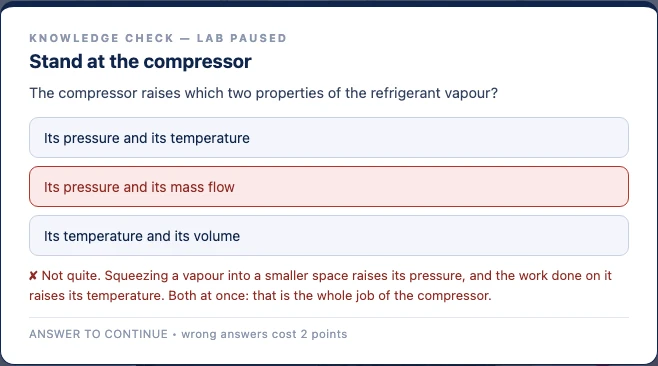
An actual Titan refrigeration knowledge check explains how compression raises refrigerant pressure and temperature after an incorrect answer.
HVAC · Feedback after a decision

The explanation is part of the activity, and a wrong answer costs points.

Open full-size image

What the credentials mean

Training and preparation do not automatically award a credential or trade license. OSHA 10 is a course-completion card; NFPA 70E awareness is training content. Required completion, examination, and licensing conditions apply. Review the included credential attempts and administration for your chosen program in the proposal.

See the course behind the outline.

Choose a program for your demo. We will walk through the lessons, virtual practice, and reporting.

Book your program demo